Mobile apps we build
Customer apps, staff tools and focused business applications shaped around a defined workflow, audience and measurable operational need.

We plan, design and develop mobile applications for businesses that need a practical customer, staff or operational product on iOS and Android.
The challenge
Native and cross-platform mobile applications for customer, staff and business workflows across London and the UK.
Our approach
Mobile apps can give customers or staff a focused way to complete important tasks away from a desktop browser. We define the users, workflows, platform choice, backend connections and release scope before development begins, keeping mobile products distinct from broader CRM, ERP, POS, portal and internal-system work.
Mobile app capabilities
Customer apps, staff tools and focused business applications shaped around a defined workflow, audience and measurable operational need.
Bespoke interfaces and functionality are planned around the product rather than forcing a business process into a generic template.
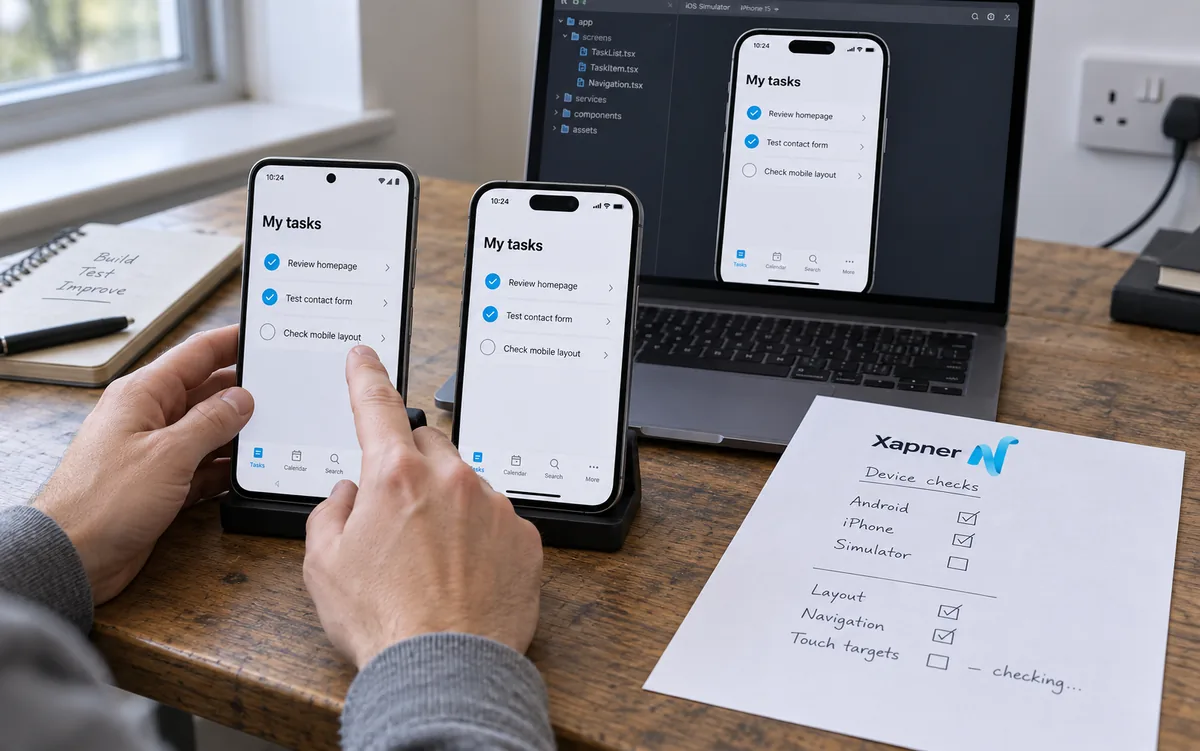
iPhone and iPad experiences can be delivered natively or through an appropriate cross-platform codebase, based on scope and device requirements.
Android applications are designed for the agreed devices, operating-system support and Google Play distribution requirements.
Flutter or React Native can provide one maintainable product codebase for iOS and Android when the required features and integrations suit a cross-platform approach.
We compare user experience, device access, performance, delivery risk and long-term maintenance before recommending native or cross-platform development.
Apps can support bookings, customer accounts, field work, staff tasks, approvals, dashboards and other agreed mobile workflows.
Secure APIs can connect an app to an existing CRM, ecommerce platform or operational backend, subject to available access and documented integration capability.
Navigation, states, forms, touch targets and core journeys are designed for small screens and real mobile use before development is finalised.
The agreed scope can include device testing, release preparation and submission support for Apple App Store and Google Play. Store acceptance remains controlled by Apple and Google.
Projects define source-code ownership, repositories, access and handover. Ongoing maintenance and phased development can be arranged separately after launch.
Listed so there are no surprises at invoice stage. Anything here can usually still be arranged — it is quoted separately rather than assumed.
Delivery depends on product scope, platform choice, integrations, content, testing and store-review requirements. Discovery produces a written phased timeline; no fixed build time is assumed.
After agreed fees are paid, the client owns the bespoke source code and original deliverables created for the project, subject to third-party libraries, platform terms, licences and the written agreement. We provide the agreed repositories, access and handover guidance.
Delivery
Define users, business goals, priority journeys, platforms, integrations and the first viable release.
Map flows, interface states, data, API responsibilities, security considerations and the native or cross-platform approach.
Create mobile-first screens and interactions for review before full implementation.
Build the approved application and agreed API, authentication, payment, notification or business-system connections.
Test important journeys, supported devices, permissions, integrations and release builds, then resolve agreed acceptance issues.
Prepare agreed listings and release files and support submission; Apple and Google independently control review and approval.
Transfer agreed access and source materials, then continue with separately scoped maintenance or product phases where required.
Quick enquiry
We aim to reply within one business day.
Cost depends on platforms, screens, workflows, backend requirements, integrations, testing and release scope. We confirm a written scope and GBP price after discovery rather than publishing an unsupported fixed figure.
Timescale depends on scope, platform choice, integrations, content, testing and store review. Discovery produces a phased delivery plan; no fixed timescale applies to every app.
Yes. We can build for iOS and Android using native or suitable cross-platform technology according to the agreed product requirements.
The choice depends on device features, performance, user experience, existing technology and maintenance needs. We recommend an approach after technical discovery rather than treating one framework as universally best.
Yes, where the existing system provides suitable access or APIs. We review authentication, data ownership, rate limits, security and integration scope before confirming delivery.
After agreed fees are paid, the client owns bespoke source code and original deliverables created for the project, subject to third-party licences, platform terms and the written agreement.
We can support release preparation and submission where included in scope. Apple and Google control developer-account eligibility, review, approval and ongoing store availability.
Yes. Maintenance, monitoring, compatibility updates and further product phases can be agreed separately after the included handover or support period.
Yes. We work with businesses across London and the wider UK through an agreed remote or project-specific arrangement. This page does not represent a London office.
Published apps by Xapner
Real applications published through Xapner’s official Apple App Store and Google Play developer profiles.

Mobile food ordering
iOS and Android
Published iOS and Android ordering app with menus, options, cart, checkout, delivery, collection and order tracking.
Productivity application
iOS and Android
Published reminder app designed to keep asking until an important task is explicitly confirmed as done.
Business integration application
Android
Published Android app for discovering and connecting printers used in POS and other business printing workflows.
Next step
Share your goals and we will recommend a practical scope, timeline and next step.
No purchase required
Tell us what you want to build, who will use it and which systems it needs to connect with. Xapner can help plan the right iOS, Android or cross-platform solution.
We use essential cookies to run the site. Optional analytics and advertising run only with your consent. See the cookie policy or .