Internal business systems
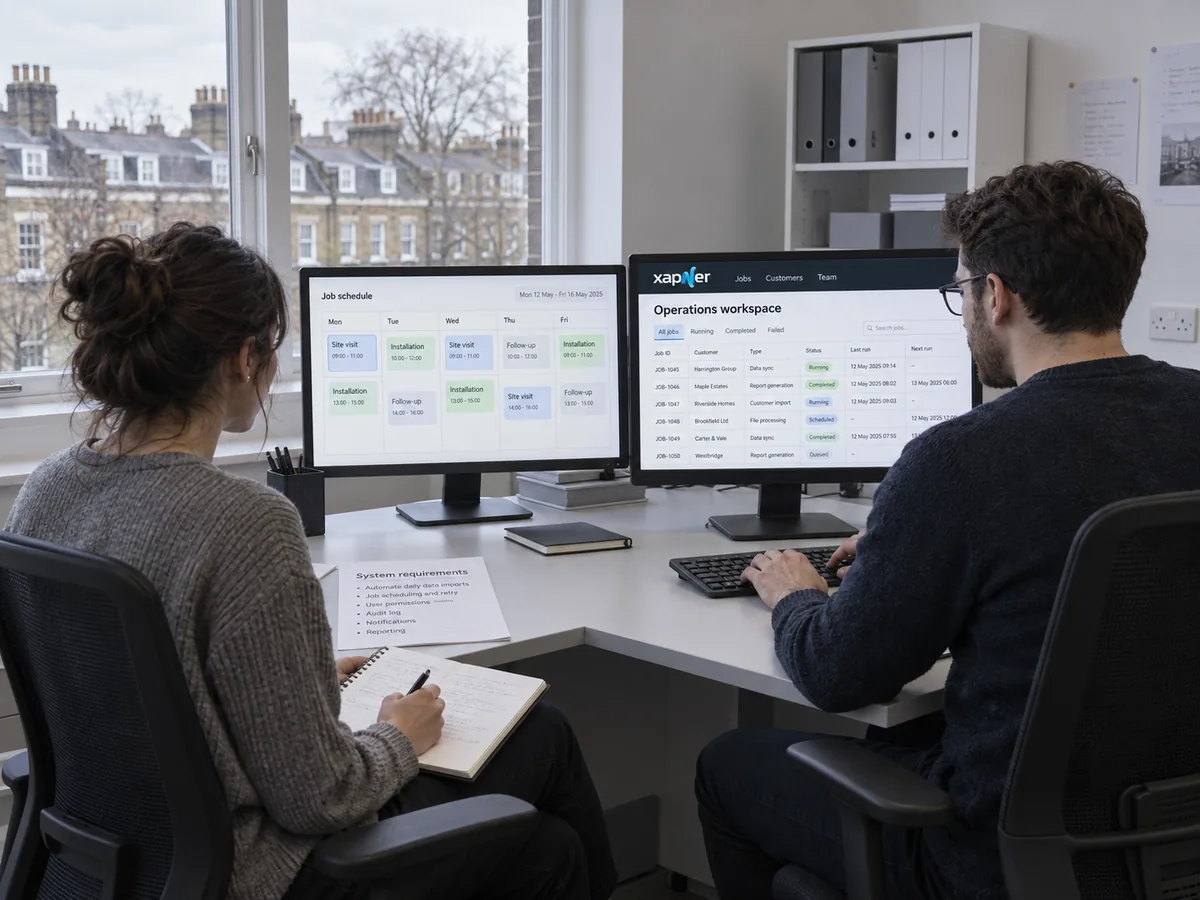
Purpose-built tools for managing customers, operations, approvals, stock, jobs, documents and reporting in one dependable workflow.

Software development for London businesses
We design and build business software around the way your team actually works. From customer management and operational platforms to portals, integrations and automation, every project starts with the problem to solve—not a fixed template.
What we build
Purpose-built tools for managing customers, operations, approvals, stock, jobs, documents and reporting in one dependable workflow.
Secure web applications, portals and ordering experiences that give customers a clearer way to interact with your business.
Integrations and automation that move information between the tools you already use and reduce repetitive administration.
Business problems
Development services
Customer records, pipelines, tasks, communications and reporting shaped around your sales and service process.
Connected tools for stock, jobs, purchasing, fulfilment, finance handoffs and management visibility.
Browser-based point-of-sale and operational interfaces designed for the people using them during real working days.
Responsive applications for customers, partners and teams, with secure access and clearly defined roles.
APIs, data synchronisation, notifications and approval flows that connect existing systems without unnecessary replacement.
A bespoke CRM can reflect the stages, information and responsibilities your team already uses. We can plan customer records, lead pipelines, tasks, permissions, communication history and practical reporting without forcing an unsuitable generic workflow.
When operations have outgrown separate files and manual handoffs, a focused ERP or internal platform can bring jobs, inventory, suppliers, fulfilment and reporting into a shared system. Scope is defined around the processes that genuinely need to connect.
We build browser-based POS and ordering workflows, including interfaces for counter teams, kitchen fulfilment and local printing. Hardware, payment and third-party integration requirements are agreed during discovery.
Customer portals, partner areas, dashboards and internal web apps can make information and actions available from any modern browser. Access controls, data handling and ownership are planned before development begins.
Existing tools do not always need replacing. We can connect suitable APIs, automate repeatable handoffs and create a clearer layer between systems, subject to the access and limits of each provider.
Delivery process
Map the users, current workflow, constraints, required integrations and the outcome the software must support.
Define the first useful release, data structure and key screens before committing to a larger build.
Develop in reviewable stages, test important journeys and incorporate agreed feedback at clear checkpoints.
Prepare production, document the agreed system and confirm support, access and ownership arrangements.
Technology
Proof in practice
Public-safe examples of custom platforms, commerce systems and device integrations.
Custom communications platform
A custom business communications and dialler platform; only its public login surface is referenced here.
Insurance estimation platform
A public customer-acquisition platform that guides visitors through health-plan estimate questions.
Restaurant commerce platform
A restaurant ordering ecosystem covering the customer journey from menu discovery through fulfilment and order history.
Device integration product
A local bridge connecting business applications to Bluetooth, Wi-Fi and USB printers.
Why Xapner
Software, web interfaces and automation can be considered together instead of split across disconnected suppliers.
Requirements, exclusions, dependencies and third-party costs are clarified in writing before delivery.
Projects can begin with discovery or a focused first release, reducing the risk of building unnecessary features.
FAQs
Custom software development is the design and build of a system for a specific organisation, workflow or user group rather than configuring a generic product for everyone.
Bespoke software development means creating software around your particular requirements. In practice, bespoke and custom software are commonly used to describe the same tailored approach.
Cost depends on scope, user roles, integrations, data migration, security needs and support. We review the brief before confirming a written scope and price; complex projects are not given an automatic estimate.
Timescales depend on the number of workflows, integrations and review stages. A focused first release may be delivered sooner than a broad platform; the proposed stages and assumptions are confirmed after discovery.
Yes. We can scope and build custom CRM workflows, operational and ERP-style systems, browser-based POS tools and connected business platforms where the requirements fit its delivery capabilities.
Yes, where the existing system provides suitable and authorised access. Feasibility depends on its API, documentation, rate limits, data quality and security requirements.
Yes. We work with businesses across London and elsewhere in the UK. Meetings and delivery can be handled remotely, with the working arrangement agreed for the project; this page does not represent a London office.
Start a conversation
Share the workflow, users and systems involved. Xapner will review your brief and recommend a practical next step.
Start your enquiryWe use essential cookies to run the site. Optional analytics and advertising run only with your consent. See the cookie policy or .